
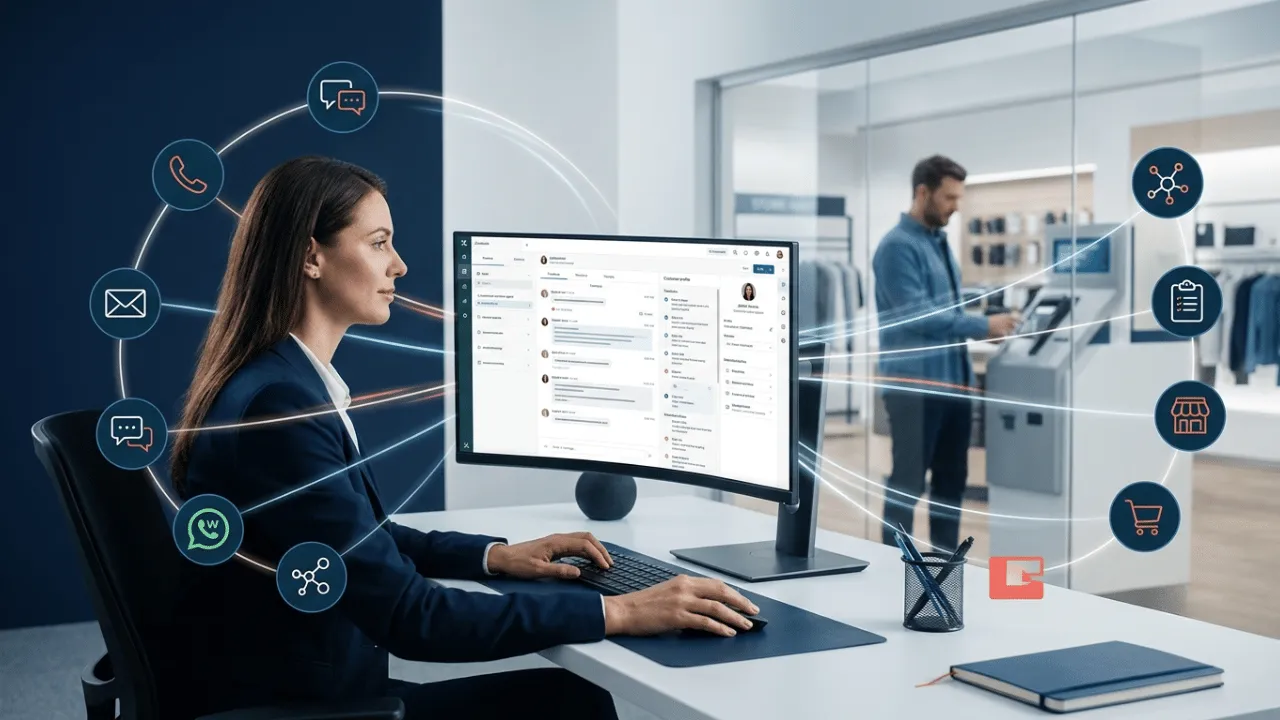
Design a Zendesk-powered customer experience model that delivers the same quality of service across phone, email, chat, web and in-person interactions—whether you serve retail customers, passengers or complex B2B accounts.
Customers do not think in channels. They do not care whether their conversation started through a web form, a phone call, WhatsApp, email, social media or a face-to-face interaction.
They simply expect your organisation to recognise them, understand what has already happened and help them move forward without asking them to repeat the same information.
In reality, many B2C and B2B service operations still manage each channel as a separate island. Customer data is fragmented, teams work with different tools and the quality of the experience changes depending on where the conversation begins.
An effective omnichannel model connects every touchpoint through one consistent operating structure.
With Zendesk at the centre, organisations can bring conversations, customer context, workflows and reporting together—creating a unified experience across channels, brands, teams and geographies.
An omnichannel CX strategy helps you:
Schedule an Omnichannel CX Design Session
Omnichannel is not a one-size-fits-all model.
B2C and B2B organisations face different customer expectations, operational rhythms and levels of complexity. However, both experience the same underlying problems when conversations, data and processes are fragmented.
The design of the service model must reflect the journey, but the objective remains the same: maintaining context and quality wherever the conversation starts.
B2C organisations often manage large volumes of customer interactions within short service cycles.
A retailer such as The Cotswold Company must connect customer journeys across physical stores, ecommerce, delivery operations and contact centre support while serving thousands of customers every week.
Travel and transport organisations such as Baleària face an even broader challenge. Customer journeys can include research, booking, payment, port access, boarding, onboard services and post-travel support.
During these journeys:
When channels are disconnected, customers are forced to repeat themselves and agents lack the context required to resolve issues efficiently.
B2B service operations usually manage fewer individual contacts, but each interaction can involve more people, more data and more operational risk.
A global service provider such as activpayroll manages payroll activity across different countries, jurisdictions and regulatory environments.
A single enquiry may involve:
B2B relationships also extend over longer periods. Conversations may move between email, portals, meetings and support systems over several days or weeks.
For these organisations, consistency is not only about speed. It also depends on:
The journeys may be different, but the requirement is the same: one unified operating model that maintains context, quality and accountability across every channel.
The Cotswold Company operates 15 physical stores, a busy ecommerce platform and a contact centre, serving thousands of customers every week.
Its customer journeys stretch across retail, digital commerce and logistics. A customer may discover a product online, visit a store, arrange delivery and later contact the support team about an order.
Previously, these stages were managed through fragmented processes, making it difficult to provide a consistent experience from beginning to end.
The organisation faced several barriers to delivering a unified retail experience:
The result was unnecessary friction at different stages of the journey.
The transformation required more than implementing a new platform. It also involved creating clearer ownership and alignment across the business.
The Cotswold Company:
These changes helped teams understand each customer journey as one connected experience rather than a series of isolated transactions.
The Cotswold Company created a more scalable and consistent customer experience model.
The transformation contributed to:
The result was not simply better ticket management. Customer experience became a more visible and strategic part of the business.
Read The Cotswold Company customer experience story
Baleària operates passenger and freight routes across Spain, the Balearic and Canary Islands, North Africa and the Americas.
Its customer ecosystem includes individual passengers, freight clients, commercial partners and internal teams. Each group interacts with the organisation in different ways and at different stages of the journey.
The objective was to provide a seamless experience across physical and digital touchpoints while achieving service standards comparable to those associated with airlines.
Baleària’s scale and business diversity created significant operational complexity:
Creating consistency required an integrated approach that could support B2C, B2B and B2B2C relationships within one environment.
redk and Baleària designed an integrated CX model covering all business lines and regions.
The transformation included:
This created a common service foundation while preserving the workflows required by each audience.
The new model allowed Baleària to deliver more consistent experiences across physical and digital touchpoints.
Key outcomes included:
Baleària demonstrated that omnichannel CX can support highly complex journeys without forcing every customer type into the same process.
Explore Baleària’s omnichannel transformation
activpayroll provides global payroll services across multiple countries and regulatory environments.
Its clients rely on the organisation to manage sensitive, time-critical processes involving payroll, employment data and local compliance requirements.
Unlike short B2C journeys, global payroll support often involves long-running interactions between several teams and stakeholders.
activpayroll’s service environment reflects many of the most demanding characteristics of B2B customer experience:
In this type of environment, losing context between channels is not simply inconvenient. It can create delays, duplicate work and increased compliance risk.
A unified service model gives teams one place to understand account history, coordinate actions and maintain consistent communication throughout the relationship.
Discover how omnichannel service supports complex B2B operations
Although B2C and B2B journeys differ, the path towards omnichannel consistency follows a similar pattern.
The objective is not to force every interaction into one identical process. It is to create one operating model capable of preserving context while adapting to different customers, channels and levels of complexity.
Begin by identifying the most important journeys for each audience.
For B2C organisations, these may include:
For B2B organisations, priority journeys may include:
For each journey, document:
This creates a clear view of where fragmentation is affecting the experience.
Learn how to map omnichannel customer journeys
An omnichannel operation should treat each customer or company relationship as one connected conversation.
That means defining what a complete customer story should look like inside Zendesk.
Consider:
In B2C, the focus may be on recognising one individual across chat, email and phone.
In B2B, the model may need to connect multiple contacts, departments and service requests to one organisation.
The structure changes, but the principle remains the same: every interaction should add context rather than create another isolated record.
Explore unified customer data in Zendesk
Every channel captures information differently.
A web form may contain structured fields, while an email may arrive as unstructured text and a phone call may depend on the notes recorded by an agent.
An effective omnichannel model normalises this information before routing the request.
This can involve:
Cases should be routed according to intent, urgency, customer type and account context—not simply according to the channel they came from.
A complex payroll enquiry should reach the correct specialist whether it starts through email or a portal. A delivery issue should follow the correct retail workflow whether the customer uses chat or phone.
Discover intelligent routing with Zendesk
Agents need access to the same reliable information across every channel.
A unified knowledge environment can support:
Inside the agent workspace, teams should be able to see:
This allows the organisation to deliver a consistent answer regardless of where the conversation started or which team handles it.
Knowledge can also support self-service and automation, reducing unnecessary contacts while preserving access to human support when needed.
Learn how to create a unified knowledge environment
Channel-level reporting is useful, but it does not provide a complete view of the customer experience.
An omnichannel measurement model should examine how the entire journey performs.
Relevant metrics include:
For example, a chat channel may appear efficient in isolation. However, if customers frequently move from chat to phone because their issue remains unresolved, the overall experience is not working.
The objective is to understand whether customers receive consistent, effective support across the entire journey.
Explore omnichannel reporting and analytics
Omnichannel means customers can move between phone, email, chat, social media, forms, websites and in-person interactions without losing context, quality or speed.
From the organisation’s perspective, it means using one operating model and one connected data foundation to support every touchpoint.
It is not simply about offering many channels. It is about ensuring those channels work together.
B2C customer journeys are generally shorter, higher-volume and more emotional. Customers frequently change channels and often expect immediate responses.
B2B journeys tend to be longer, more complex and involve multiple stakeholders. Email, portals and scheduled interactions usually play a greater role, while auditability and account context become especially important.
The core design principles remain the same, but routing, SLAs, data structures and knowledge must reflect the needs of each segment.
Begin with one or two priority customer journeys.
Identify where information is lost, where customers repeat themselves and where teams rely on disconnected systems.
Then centralise those journeys in Zendesk using:
Organisations such as The Cotswold Company and Baleària began by unifying their most important journeys before expanding the model further.
No.
Omnichannel does not require every channel to be available for every interaction.
The objective is to offer the right combination of channels while maintaining a consistent experience between them.
Some journeys may be best handled through self-service. Others may require phone, email or specialist human support.
The channel strategy should be based on customer needs, operational complexity and the value of each interaction.
Yes.
Zendesk can support high-volume B2C interactions as well as complex B2B account relationships.
The platform can be configured with different:
The key is designing the operating model around the organisation’s real customer journeys rather than applying one generic process to every audience.
A successful omnichannel model should reduce friction for customers and improve visibility for teams.
Signs of progress include:
The most important question is not whether each channel performs well independently. It is whether the complete customer journey feels connected.
Whether you serve retail customers, passengers, commercial partners or global B2B clients, your customers should not feel the operational gaps between channels.
A connected service model allows every interaction to contribute to one coherent customer story.
With Zendesk as the central platform, redk can help you unify customer data, conversations, routing, knowledge and reporting across your organisation.
The result is an omnichannel experience that maintains context and quality—regardless of where the conversation begins.
Schedule an Omnichannel CX Design Session