Design a Zendesk-powered service operation that performs under pressure—whether you're managing product launches, major campaigns, live events, outages or seasonal peaks—without compromising response times or customer trust.
Most customer service operations are designed to perform well on an average day. The real challenge begins when demand suddenly surges.
A product launch, a major marketing campaign, a billing cycle, a service outage or a high-profile event can multiply contact volumes within minutes. When queues, routing rules and operational playbooks aren't designed for these scenarios, even experienced teams and robust technology begin to struggle.
Peak CX is about building a customer service operation that remains efficient, organised and consistent when demand reaches its highest point.
With Zendesk at the core of your service model, organisations can absorb spikes in demand while maintaining visibility, governance and a high-quality customer experience.
A Peak CX strategy helps you:
Run a Peak CX Readiness Workshop
Every industry experiences peak periods differently.
For sports organisations, it may be matchdays or ticket releases. For ecommerce businesses, product launches or flash sales. Utilities experience billing cycles and service outages, while public organisations manage admissions, public announcements and emergency communications.
Although the scenarios differ, the operational pattern is remarkably similar.
During peak periods:
When queues, SLAs and routing logic are designed only for business-as-usual operations, organisations typically experience:
Ironically, the moments when customers most need reassurance are often when service operations are under the greatest pressure.
Across multiple industries, redk helps organisations build customer service operations capable of managing high volumes and business-critical interactions under significant time pressure.
These include sports organisations, membership associations, ecommerce businesses, utilities and other high-volume service environments.
In a Peak-Ready operation:
Peak CX means creating one governed Zendesk environment capable of supporting your organisation when demand is at its highest.
Instead of reacting to operational pressure, your teams work from predefined playbooks that provide consistency, visibility and control.
Discover how Zendesk supports high-volume customer service operations
Use this quick assessment to evaluate how prepared your organisation is for periods of exceptionally high demand.
If two or more of these statements sound familiar, your organisation is likely carrying unnecessary operational risk into every campaign, launch or major event.
A Peak CX Readiness Workshop provides a clear assessment together with practical recommendations tailored to your organisation.
Based on years of experience supporting high-volume customer service operations, redk has developed a practical framework for designing service models that absorb demand spikes without compromising customer experience or governance.
Start by mapping every event capable of generating unusually high demand.
Examples include:
For every event, identify:
Understanding these scenarios allows you to prepare before demand arrives.
Learn how to map customer contact drivers
Not every customer interaction deserves the same priority.
During peak periods, organisations should classify enquiries according to business impact, including:
Routing rules should ensure that critical interactions bypass general queues and immediately reach specialist teams.
Zendesk enables organisations to automate this process using triggers, forms, skills-based routing and workflow automation.
The objective is simple:
The right customer reaches the right specialist at the right time.
Explore intelligent routing with Zendesk
Standard configurations rarely work during exceptional events.
Instead, create dedicated operational models for each major scenario.
This may include:
For example, during a major product launch, payment issues, account access requests and order confirmations can each follow different workflows managed by specialist teams.
Simple, documented playbooks reduce uncertainty and help agents make faster, more consistent decisions.
Learn how to design Zendesk workflows
During peak periods, agents cannot afford to waste time searching across multiple systems.
They need immediate access to accurate information inside Zendesk.
This includes:
Integrating Zendesk with your core business platforms enables agents to resolve customer enquiries without switching between multiple applications.
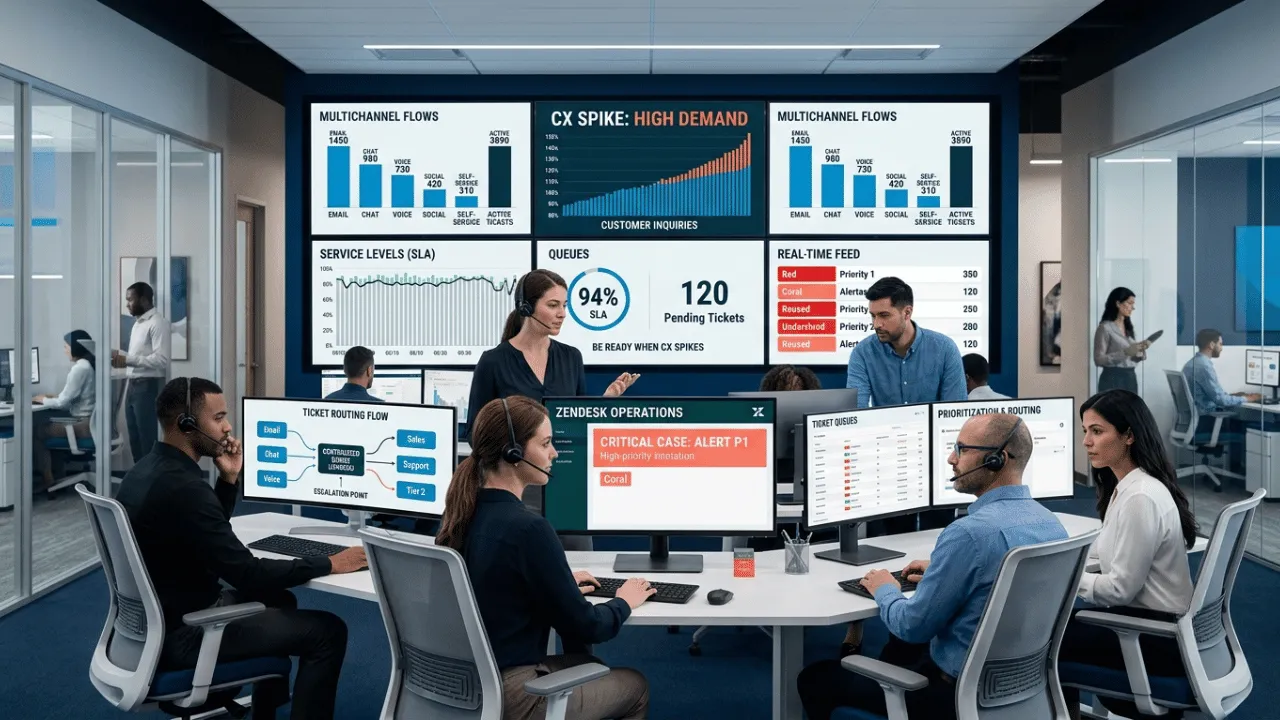
Meanwhile, operational dashboards give managers live visibility into:
This allows leaders to make informed decisions while events are still unfolding.
Discover Zendesk integrations for complex service operations
Every peak event provides valuable operational insight.
After each campaign, outage, launch or event, review:
Use these findings to improve routing rules, playbooks, knowledge content and reporting before the next peak arrives.
Every event becomes an opportunity to strengthen your customer service model.
The goal isn't simply surviving peak periods.
It's building an operation that becomes more resilient every time demand increases.
Explore Zendesk reporting and analytics
A peak is any period where customer demand increases significantly above normal operating levels.
Examples include product launches, flash sales, sporting events, billing cycles, outages, public announcements or crisis communications.
These periods place far greater pressure on routing, governance and operational capacity than business-as-usual service.
Additional staff certainly increase capacity.
However, without clear routing rules, queues and operational playbooks, extra people often introduce more complexity rather than solving it.
Peak CX ensures every additional resource is focused on the right issues at the right time.
Zendesk provides a single omnichannel platform where organisations can manage:
redk designs the operational model around Zendesk so the platform reflects your real business events and customer journeys.
Discover redk's Zendesk services
Traditional CX initiatives often optimise for average operational performance.
Peak CX starts with the most demanding situations first.
Once your organisation performs confidently during its busiest days, normal operations naturally become more efficient.
Implementation depends on your existing architecture, operational maturity and business complexity.
However, many organisations begin seeing measurable improvements after the first few peak cycles once routing, queues and playbooks have been redesigned.
Continuous optimisation then builds on each successive event.
During a 60–90 minute workshop we:
Demand spikes shouldn't become moments of operational stress.
With the right service design, Zendesk configuration and governance model, your organisation can move from reactive firefighting to a structured, resilient customer experience operation.
Whether you're preparing for major launches, sporting events, seasonal campaigns or critical incidents, redk can help you design a Peak-Ready CX model built around Zendesk.
Run a Peak CX Readiness Workshop