

From marketing automation to autonomous agents: key takeaways from redk and Salesforce’s Madrid event
Artificial Intelligence is changing marketing. But the most important shift is not simply about doing what we already do, faster.
For years, marketing teams have relied on automation to execute campaigns, segment audiences and activate journeys. We are now entering a new phase: agentic marketing, where AI agents can take a much more autonomous role in decision-making and execution.
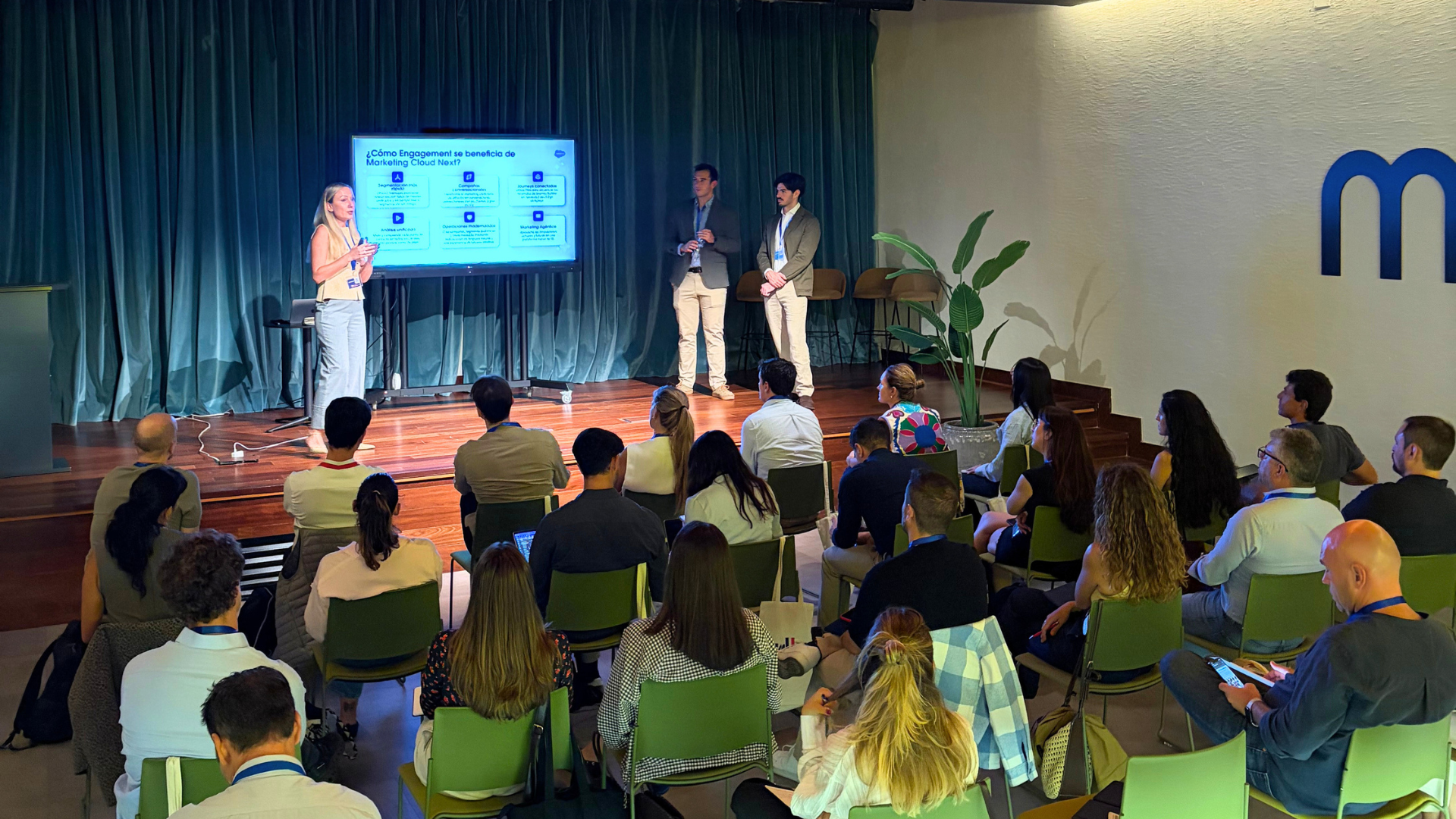
This was one of the key themes explored at our latest event in Madrid, “How to scale your marketing strategy with AI”, hosted by redk and Salesforce.
We brought together marketing and CRM professionals to explore how AI is transforming acquisition, engagement and conversion, and what it means to move from automation towards a marketing model powered by intelligent, autonomous agents.
Marketing automation has been fundamental to scaling marketing for years.
But there is an important difference between automating a task and giving an agent the autonomy to decide what to do, execute it and optimise its actions based on context.
That is the shift behind agentic marketing.
Predictive AI helps decide: identifying opportunities, optimising campaigns, forecasting demand and improving lead scoring.
Generative AI helps create: content, messaging, creative assets and personalised experiences.
And agentic AI helps execute: coordinating actions, interacting with customers, orchestrating journeys and acting autonomously towards defined objectives.
The evolution, therefore, is not simply about automating more processes.
It is about giving agents the ability to act.
For marketing teams, this shift could be particularly significant.
Until now, much of the marketing operation has been built around predefined workflows: if A happens, do B.
With agents, this model can evolve towards systems that can interpret context, make decisions and execute different actions to achieve a defined objective.
During the event, we explored how this approach can be applied across the marketing lifecycle — from campaign creation and execution to personalisation, journey orchestration and continuous optimisation.
This means moving beyond the question of which tasks can we automate? and asking:
Which decisions and actions could an agent take to help us achieve our marketing objectives?
In this new landscape, Agentforce represents an evolution in the role that agents can play within an organisation.
During the Salesforce session, we explored how Agentforce connects with Customer 360 and Data 360, bringing together agents, data, applications and workflows within an architecture connected to the real context of the business.
This is particularly important for marketing.
An agent cannot make effective decisions without the right context: who the customer is, what they have done, which campaigns they have received, what they are interested in or where they are in the customer journey.
That is why the move towards autonomous agents is closely linked to another evolution: the ability to work with unified, accessible data in real time.
This model goes far beyond a single AI assistant.
During the event, we explored different capabilities within Agentforce Marketing, with specialised agents supporting different areas of the marketing strategy.
These include:
The goal is for these agents to work together to help teams move from isolated campaigns towards more dynamic, connected marketing experiences.
Another important theme we explored was the evolution of the relationship between brands and customers.
For a long time, marketing has largely operated as a one-way model: a business creates a message, selects an audience and sends it through a channel.
AI is opening the door to something different.
Rather than simply sending communications, brands can begin to create two-way conversations, where the customer's interaction becomes an active part of the experience.
This also changes how we think about engagement.
It is no longer simply about sending the right message to the right segment. It is about being able to adapt the experience based on context and what is happening during each interaction.
Talking about autonomous agents does not mean that data has become less important. Quite the opposite.
The more autonomy we give agents, the more important it becomes that they can access information that is reliable, relevant and connected.
During the session, we explored how Data 360 enables organisations to work with data from different sources, build unified profiles and activate that information across different experiences and channels.
Because autonomy without context can lead to irrelevant actions.
An agent needs data to know what to do, context to understand why it should do it, and clear objectives to know where it is heading.
The move towards agentic marketing does not mean every organisation needs to adopt exactly the same model.
During the event, we also explored Marketing Cloud Next and Marketing Engagement, and how to understand when to use each solution based on an organisation's objectives and requirements.
Marketing Cloud Next takes a CRM-first, native Salesforce approach, connected to sales, CRM, AI and Data 360. It enables teams to build journeys closely connected to customer context and take advantage of AI capabilities within the marketing experience.
Marketing Engagement, meanwhile, is designed for advanced multi-channel marketing execution and managing complex campaigns and large volumes, with capabilities including Journey Builder, advanced segmentation and Data Extensions.
The question, therefore, is not which solution is better.
It is what each organisation needs and what kind of marketing model it wants to build.
Autonomy is also changing the relationship between marketing and sales.
During the event, we explored the example of Piper, Qualified's AI SDR Agent, designed to work continuously with inbound leads and at scale.
Piper can interact with leads across different channels, work across languages and help move conversations through the funnel. It can also coordinate with other agents within the wider ecosystem.
Applications like this show where demand generation could be heading: from processes where teams need to manually intervene at every stage towards models where specialised agents can take ownership of specific interactions and actions autonomously.
Talking about agents, autonomy and AI only matters if we can connect these concepts to real business challenges.
That is why one of the most valuable parts of the event was the roundtable on real-world experiences of automation, engagement and AI in marketing, featuring Mar Juárez from IVIRMA and Luis Vigo from Adams.
The discussion brought real-world challenges to the table: where AI makes sense, how processes evolve, which opportunities exist to automate or delegate specific tasks, and how teams need to adapt as these initiatives move from strategy into day-to-day operations.
Because the goal is not to have more technology.
It is to enable teams to spend more time on the decisions that create real value.
The transition towards Agentic Marketing has already begun, but every organisation is starting from a different point.
The question should not simply be which agent can we introduce? It should be where agents can genuinely create value within the marketing strategy.
Which processes could benefit from greater autonomy?
What data does an agent need to act with context?
Which decisions should remain under human oversight?
And how will we measure the impact on the business?
These are the questions that can help organisations move beyond experimenting with AI and towards building a marketing strategy ready for the next stage.
At redk, we help organisations identify opportunities to apply AI, prioritise use cases and define how to evolve their marketing strategies with Salesforce.
Because the next step in marketing is not simply to automate more. It is to enable technology to do more for your team.
Explore how AI and autonomous agents could support your marketing strategy.