What to watch as Salesforce shapes the next era of CRM and AI.
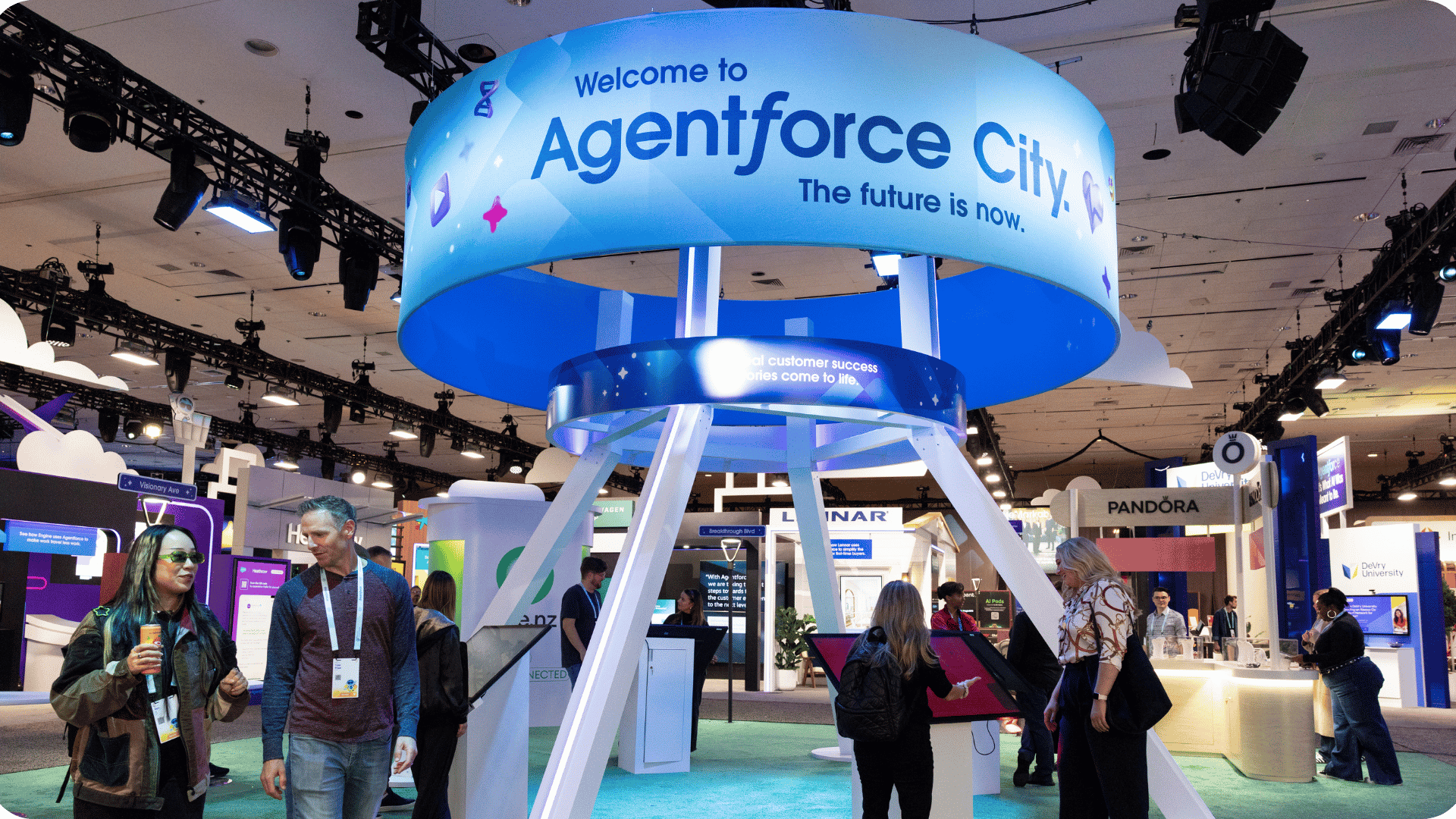
Dreamforce 2026 is almost here.
Taking place in San Francisco from 15–17 September, this year's event will bring together Salesforce customers, partners, developers and business leaders around a clear theme: the Agentic Enterprise.
Salesforce is positioning this year's Dreamforce around how people, AI agents, data and platforms can work together to transform how businesses operate. With more than 1,600 breakout sessions, 50+ keynotes, 150+ hands-on trainings and demos, and 240+ community roundtables, there will be no shortage of announcements and ideas to explore.
But with so much happening across three days, the challenge isn't finding information. It's knowing which developments are actually worth paying attention to.
Ahead of Dreamforce, Salesforce has already given us some strong signals about where its platform is heading. Here are the trends we'll be watching most closely.
The biggest theme at Dreamforce 2026 is unlikely to be simply "AI".
Salesforce is moving towards a model in which AI agents don't just answer questions or assist employees, but can reason, orchestrate and take action across business processes.
The direction is already visible across the Dreamforce programme. Salesforce is highlighting Agentforce alongside Headless 360, Data 360 and Slack as key building blocks for the Agentic Enterprise, with dedicated sessions and hands-on experiences focused on building and deploying agents.
Salesforce's Agentic Enterprise Index also points to rapidly growing adoption, with the company reporting that agent deployments have more than doubled year over year.
This makes several questions particularly relevant as Dreamforce approaches:
The answers won't be the same for every organisation. An agent can only create meaningful value when the process behind it is well understood, the required data is available and the organisation has the right governance in place.
The move towards agentic AI, therefore, isn't simply a technology decision. It is also a process, data and operating model decision.
We’ll be discussing this in our upcoming webinar with three experts specialising in AI, marketing and business, so that you can find out what’s important for your particular business.
If AI agents are going to act on behalf of employees and customers, they need access to the right information and context.
This makes Data 360 another key area to watch at Dreamforce.
Salesforce is increasingly positioning data as the foundation that allows agents to understand context and take action across the organisation. Its recent expansion of Headless 360 brings together Data 360 capabilities, MCP servers, Slack integrations, developer tools and reusable agent skills, allowing authorised AI agents to discover and use Salesforce capabilities across different experiences.
For organisations exploring an agentic strategy, this puts renewed focus on:
The question is therefore moving to: "Can our people and AI agents access the right customer context wherever work happens?"
Adding AI to fragmented or unreliable data doesn't necessarily solve the underlying problem. In some cases, it simply allows organisations to automate the wrong things faster.
One of the more interesting developments to watch is Salesforce's expansion of Headless 360.
Salesforce describes Headless 360 as a way of making Salesforce capabilities available to authorised AI agents, applications and experiences through open standards. The platform brings together capabilities across areas including Data 360, Agentforce and Slack.
The strategic implication is significant.
Traditionally, CRM has been thought of as a destination: a place where sales, service or marketing teams go to access customer information and complete tasks.
The agentic model starts to challenge that idea.
Instead of requiring every employee – or every AI agent – to work directly inside the CRM interface, organisations can make CRM capabilities available wherever work takes place.
The future of CRM may therefore be less about where the CRM lives and more about where its data, context and business logic can be used.
This is one of the shifts we'll be watching closely at Dreamforce.
Salesforce's strategy also extends beyond CRM.
The relationship between Salesforce, Slack and AI agents is becoming increasingly important as Salesforce works towards a more connected agentic workplace.
Salesforce's Dreamforce programme includes dedicated experiences around Agentic Experiences in Slack, while its Headless 360 strategy brings Slack together with data, developer tools and reusable agent capabilities.
The broader direction is clear: AI doesn't necessarily need to live in a standalone AI interface.
Instead, agents can become part of the tools and workflows employees already use.
That raises an important question:
What happens when AI becomes part of the way people work, rather than another tool they have to learn?
For sales, service, marketing and operations teams, this could mean interacting with business data and AI capabilities through existing workflows and collaboration environments.
The opportunity isn't simply to introduce more AI. It is to make AI more connected to the context in which work actually happens.
Another development worth watching at Dreamforce is Salesforce's relationship with the wider AI ecosystem.
In August, Salesforce and Anthropic announced Claudeforce, bringing Claude and Salesforce together so that Claude's advanced reasoning can work with trusted Salesforce data and help turn that context into action. Salesforce has also confirmed that Anthropic CEO Dario Amodei will join Marc Benioff on the Dreamforce stage to discuss the partnership.
This is interesting because it points towards a broader direction in enterprise AI.
Organisations are unlikely to rely on a single model, interface or AI experience. Instead, the future may involve different models, agents and applications working with the same trusted business data, processes and governance.
For businesses, the strategic question becomes less about choosing "the AI tool" and more about creating an architecture in which AI can be used safely and effectively across the organisation.
AI agents are often discussed in the context of sales and customer service, but their impact on marketing could be equally significant.
Salesforce's wider platform direction points towards increasingly connected customer data, AI-driven decision-making and more automated execution.
The opportunity isn't simply to generate more content or automate more campaigns.
It is to rethink how marketing responds to customer behaviour, how teams use customer context and which parts of campaign execution could eventually be handled by AI.
For marketing leaders, Dreamforce will therefore be worth watching for developments across CRM data, personalisation, automation and AI.
The important question isn't simply how much marketing can be automated.
It's which decisions and activities benefit from automation, and where human judgement still creates the most value.
Want to go beyond the announcements? In our upcoming Dreamforce 2026 live session, three redk experts will unpack the key developments from the perspectives of AI and technology, marketing, and sales and business — helping you understand what the announcements could actually mean for your organisation.
The most important announcements won't necessarily be the ones with the biggest headlines.
Look instead at what they tell us about the direction of the Salesforce platform:
Dreamforce 2026 will provide answers to some of these questions — and likely raise many more.
At redk, we'll be following the announcements closely and looking beyond the technology itself to understand what they mean for the way organisations sell, market, serve customers and operate.
If you want to hear our perspective once the announcements are out, join our upcoming Dreamforce 2026 webinar for a live conversation with our experts across AI and technology, marketing, and sales and business.
Because the most important question after Dreamforce won't simply be: "What did Salesforce launch?"
It will be: "What does it mean for your business?"