Artificial intelligence has transformed customer service.
Yet many organisations still use the terms chatbot, generative AI and AI agent interchangeably, even though they describe very different technologies.
While traditional chatbots remain useful for handling simple, repetitive enquiries, today's AI agents can understand context, reason through complex requests and even complete tasks across multiple business systems.
So, what is the difference between a chatbot and an AI agent, and which one is right for your business?
What is a chatbot?
Chatbots have been part of customer service for many years. They are designed to automate straightforward conversations by following predefined rules or decision trees.
Traditional chatbots work well when customers ask predictable questions or follow structured journeys. Typical use cases include password resets, delivery tracking, opening hours or frequently asked questions.
A chatbot is usually best suited for:
Answering repetitive customer enquiries.
Guiding users through predefined workflows.
Reducing ticket volumes for simple requests.
Providing 24/7 self-service.
For organisations with relatively simple support requirements, chatbots remain an effective and cost-efficient solution.
However, they also have limitations. Because they rely on predefined logic, they often struggle with unexpected questions, changing context or more complex customer conversations.
What is an AI agent?
AI agents represent the next evolution of customer service automation.
Rather than following rigid scripts, AI agents use large language models (LLMs), business knowledge and company data to understand customer intent, reason through problems and decide on the most appropriate action.
Unlike traditional chatbots, AI agents don't simply answer questions. They can also perform tasks by connecting with CRM platforms, knowledge bases, ERP systems and other business applications.
Modern AI agents can:
Understand natural language and conversation context.
Access customer history and business data.
Execute actions across connected systems.
Personalise every interaction.
Continuously improve through learning and feedback.
Instead of replacing human agents, AI agents work alongside them, automating routine work while allowing employees to focus on higher-value conversations.
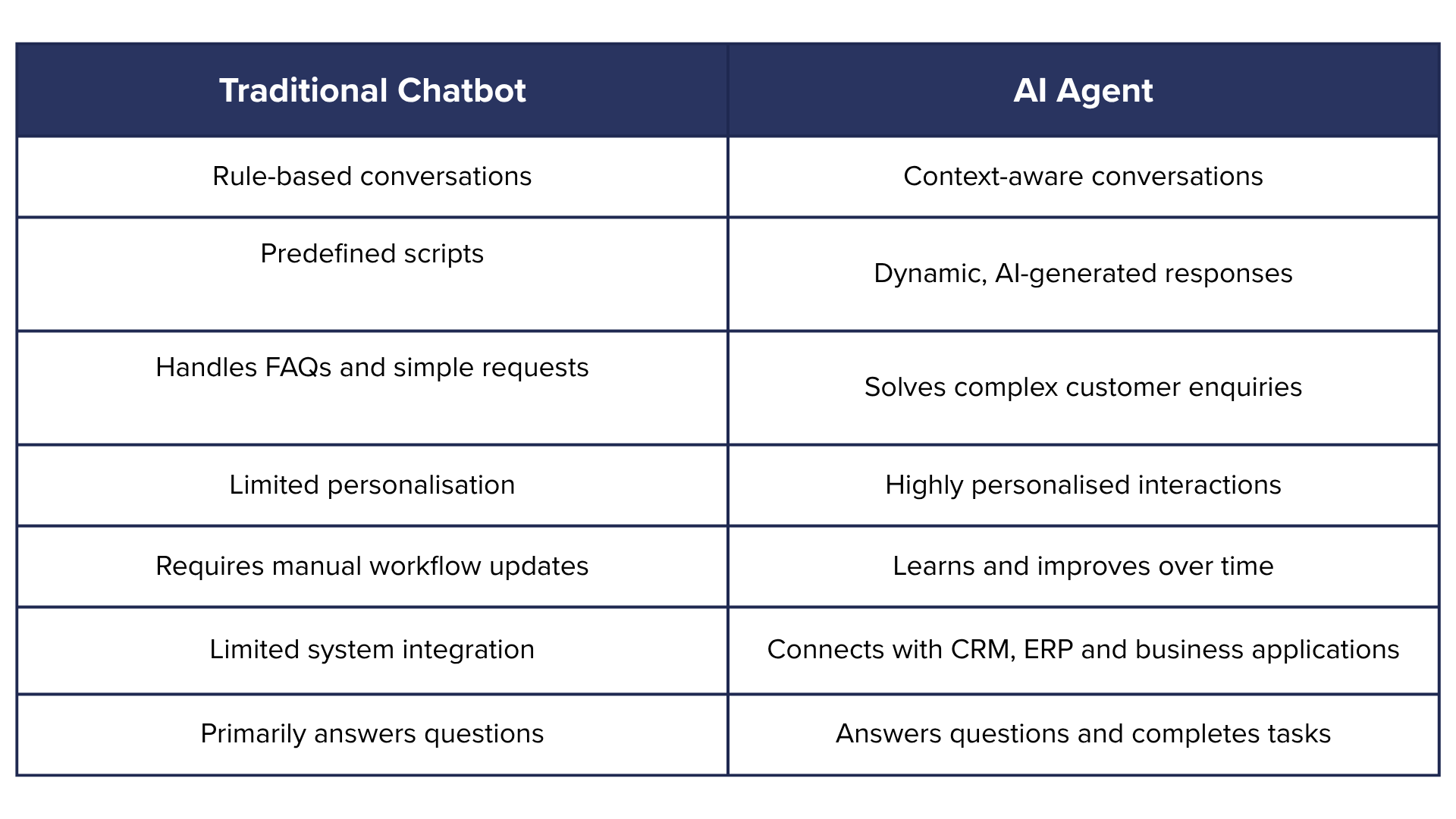
AI Agents vs Chatbots: What's the Difference?
Although both technologies automate customer interactions, their capabilities are very different.
The biggest difference is that chatbots automate conversations, while AI agents automate outcomes.
Which one should your business choose?
The right solution depends on your customer service strategy and business objectives.
If your organisation mainly receives repetitive enquiries with predictable answers, a chatbot may provide everything you need at a relatively low cost.
However, if your customer interactions involve multiple channels, complex cases or personalised experiences, AI agents offer significantly greater flexibility and long-term value.
Many organisations are now adopting a hybrid approach, combining traditional automation for simple requests with AI agents for more advanced interactions. Learn Trodo's Success Story.
How AI agents are transforming customer service
The latest generation of AI agents is changing far more than customer conversations.
By integrating with CRM platforms, knowledge management systems and business applications, they can support both customers and employees throughout the entire service journey.
AI agents are helping organisations to:
Resolve customer issues faster.
Deliver more personalised experiences.
Improve employee productivity.
Reduce operational costs through automation.
Provide consistent support across every channel.
They also enable customer service teams to move from reactive support towards proactive engagement, anticipating customer needs instead of simply responding to them.
The future of customer service is intelligent automation
Customer expectations continue to evolve, and organisations need technology that can evolve with them.
Traditional chatbots still play an important role in customer service, particularly for simple, repetitive tasks. But businesses looking to deliver more personalised, efficient and scalable experiences are increasingly investing in AI agents that can understand context, automate processes and work alongside human teams.
The question is no longer whether organisations should adopt AI. It's about choosing the right type of AI for the experiences they want to deliver.
At redk, we help organisations evaluate, implement and optimise AI solutions that create measurable business value. Whether you're exploring AI agents, modern customer service automation or a broader AI strategy, our consultants can help you identify the best approach for your business.
{ "@context": "https://schema.org", "@type": "FAQPage", "mainEntity": [ { "@type": "Question", "name": "What is the difference between a chatbot and an AI agent?", "acceptedAnswer": { "@type": "Answer", "text": "A chatbot follows predefined rules to answer common questions and automate simple conversations. An AI agent uses large language models (LLMs), business knowledge and connected systems to understand context, reason through requests and execute tasks across multiple applications." } }, { "@type": "Question", "name": "Are AI agents better than chatbots?", "acceptedAnswer": { "@type": "Answer", "text": "It depends on your business needs. Chatbots are ideal for handling repetitive enquiries with predictable answers, while AI agents are better suited to complex interactions, personalised customer experiences and business process automation." } }, { "@type": "Question", "name": "When should a business use a chatbot?", "acceptedAnswer": { "@type": "Answer", "text": "Chatbots are a good choice when customer enquiries are repetitive and follow structured workflows, such as answering FAQs, resetting passwords, tracking deliveries or providing 24/7 self-service support." } }, { "@type": "Question", "name": "When should a business implement AI agents?", "acceptedAnswer": { "@type": "Answer", "text": "AI agents are recommended when organisations need to automate complex customer interactions, access CRM and business data, personalise conversations, execute actions across multiple systems and improve operational efficiency." } }, { "@type": "Question", "name": "Can AI agents integrate with CRM platforms?", "acceptedAnswer": { "@type": "Answer", "text": "Yes. Modern AI agents can integrate with CRM platforms such as Salesforce, knowledge bases, ERP systems and customer service applications to access real-time business information and automate customer journeys." } }, { "@type": "Question", "name": "Can AI agents replace human customer service agents?", "acceptedAnswer": { "@type": "Answer", "text": "No. AI agents are designed to work alongside human employees by automating repetitive tasks, retrieving information and assisting with decision-making, allowing people to focus on complex conversations that require empathy and judgement." } }, { "@type": "Question", "name": "What are the benefits of AI agents for customer service?", "acceptedAnswer": { "@type": "Answer", "text": "AI agents help organisations resolve customer issues faster, personalise interactions, automate workflows, improve employee productivity, reduce operational costs and deliver consistent support across every channel." } }, { "@type": "Question", "name": "Can businesses use chatbots and AI agents together?", "acceptedAnswer": { "@type": "Answer", "text": "Yes. Many organisations adopt a hybrid approach, using chatbots for simple, repetitive enquiries while AI agents manage more complex conversations and business processes that require reasoning and access to enterprise data." } }, { "@type": "Question", "name": "How can redk help organisations implement AI agents?", "acceptedAnswer": { "@type": "Answer", "text": "redk helps organisations evaluate, implement and optimise AI agents across platforms such as Salesforce and Zendesk. Our consultants identify the best use cases, prepare business data and ensure AI delivers measurable improvements in customer experience and operational efficiency." } } ]
}